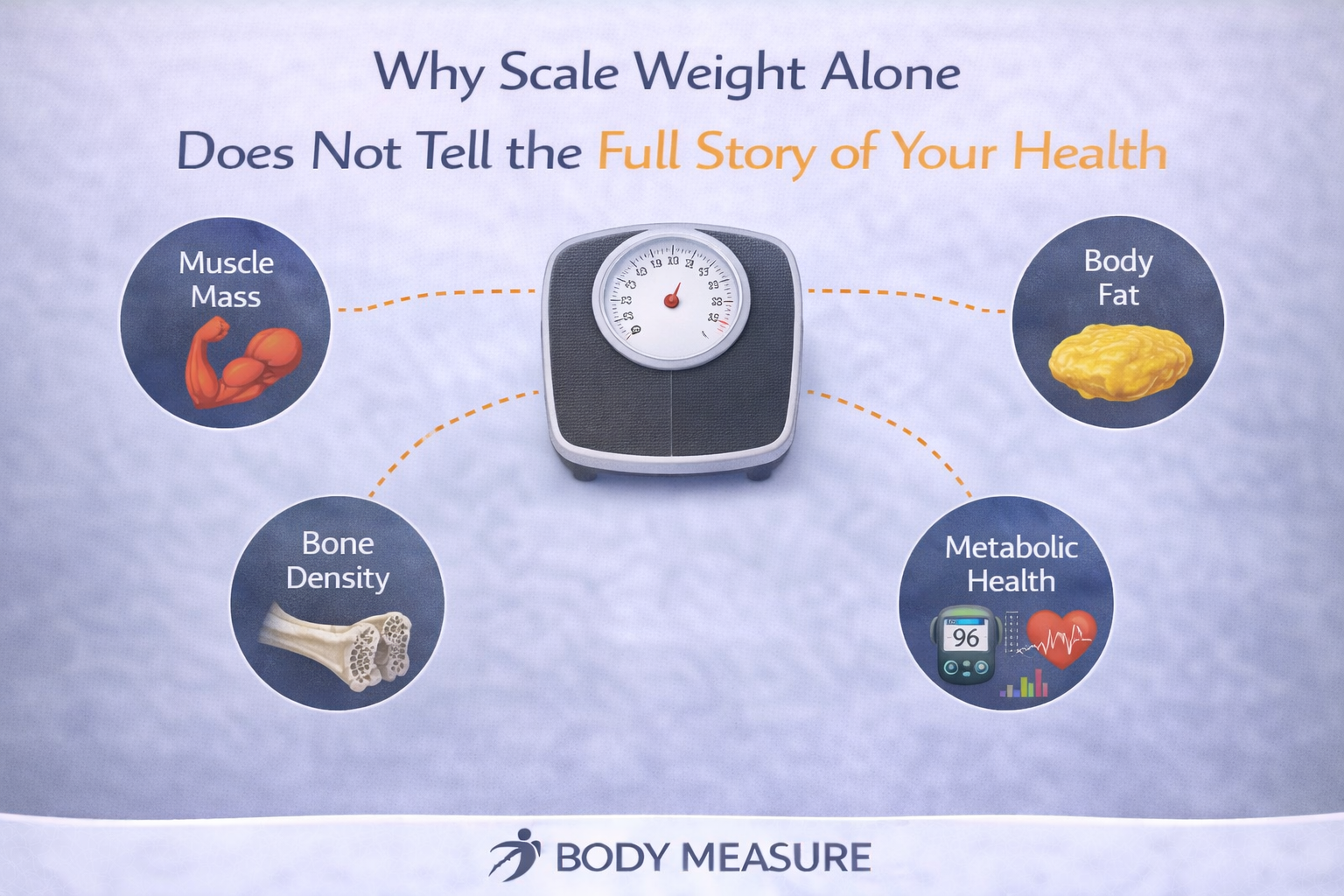
For many people, the scales are the first and sometimes only measure they use to judge progress. If the number drops, it feels like success. If it stays the same, it can feel frustrating. But body weight on its own is a very limited metric. It does not tell you how much of your body is made up of fat, lean tissue or bone, and it cannot show where body fat is stored.
This is why scale weight can sometimes create a false impression of health progress. Two people can weigh exactly the same yet have very different body composition, different fitness capacity and different health considerations. Even in the same person, weight can shift for reasons that have little to do with meaningful fat loss or muscle gain.
A better question is not simply what you weigh, but what that weight is made up of. That is where body composition testing becomes far more useful.
Key Takeaways
- Scale weight only shows total body weight, not what that weight is made up of.
- It cannot distinguish fat mass, lean mass and bone mass.
- Two people at the same weight can have very different body compositions.
- Weight changes do not always reflect fat loss or muscle gain.
- Fat distribution matters, and scales cannot show where body fat is stored.
- Body composition testing gives a more useful picture than scale weight alone.
Summary Table
| Measure | What It Can Tell You | What It Cannot Tell You |
| Scale weight | Total body weight | Fat mass, lean mass, bone mass, fat distribution |
| BMI | Weight relative to height | True body composition, muscle vs fat, fat location |
| Waist measurement | General abdominal size | Full body composition breakdown |
| DEXA body composition scan | Fat mass, lean mass, bone mass, regional distribution | Not a standalone diagnosis of all health conditions |
What the Scales Actually Measure
A standard set of scales measures one thing only: total body weight. That number includes everything contributing to your mass at that moment, including fat mass, lean tissue, bone, body water, food and fluid in the digestive system, and normal day-to-day variation.
This is why the number can move up or down even when body composition has not changed in a meaningful way. A heavier reading does not automatically mean more body fat, just as a lighter reading does not automatically mean improved health or successful fat loss.
The scales can still be useful as a broad tracking tool, but they do not explain what is driving the change. That is where many people get stuck. They are reacting to a number without knowing what sits behind it.
Why Weight Alone Cannot Show Body Composition
Body composition is about what the body is made up of, not just how much it weighs. A person’s total weight may include a high proportion of lean mass, a higher proportion of fat mass, or a mix that changes over time. The scales cannot separate those components.
That matters because health and physical progress are often shaped by more than body weight alone. Someone may gain muscle while losing fat and see very little change on the scales. Another person may lose weight quickly but also lose lean tissue along the way.
This is why body composition gives a more useful layer of context. It helps answer the question that scale weight cannot: what is actually changing in the body?
Two People Can Weigh the Same and Have Very Different Health Profiles
Two people can have the same body weight and still have very different body composition. One may carry more lean mass and less body fat, while the other may carry less muscle and a higher proportion of fat mass. On the scales, they look identical. In practice, their bodies may be functioning very differently.
This is one reason weight alone can be misleading. It does not show how much of the body is active tissue, how much is stored fat, or how those tissues are distributed. It also does not reflect differences in training background, age, recovery, or general physical capacity.
That does not mean body weight has no value, but it does mean it lacks important context. Health is not defined by a single number. The composition of that weight matters.
Why Fat Distribution Matters More Than Many People Realise
Body fat is not all stored in the same way. Where fat is carried can matter just as much as total body weight. In particular, fat stored around the abdominal region can have different health implications than fat stored elsewhere.
This is another area where the scales fall short. A person may maintain the same body weight while their fat distribution changes over time. They may also lose weight without knowing whether the change came from overall fat reduction, fluid loss, or another factor.
Understanding fat distribution adds a more useful layer to health assessment. Rather than asking only whether body weight has changed, it helps ask where change is happening and whether that change is likely to be meaningful.
Why Weight Changes Do Not Always Mean Fat Loss or Muscle Gain
Body weight can change for many reasons that have little to do with fat loss or muscle gain. Fluid balance, carbohydrate intake, sodium intake, recent exercise, digestive contents and hormonal fluctuations can all influence the number on the scales from one day to the next.
This is why people sometimes feel confused by their progress. You might be eating well, training consistently and improving body composition, yet the scales barely move. On the other hand, a sudden drop in weight does not always mean body fat has been reduced in a meaningful way.
Looking at weight in isolation can lead to the wrong conclusion. A short-term change in scale weight may be real, but that does not automatically mean it reflects the kind of change you are actually aiming for.
When Scale Weight Still Has Value
Scale weight is not useless. It can still be a helpful broad measure when viewed in context. For some people, it is a simple way to track long-term trends, notice major shifts, or support general health monitoring alongside other information.
The problem is not the scales themselves. The problem is expecting them to tell the full story. Weight works best when it is combined with other markers such as body composition, waist measurement, physical performance, energy levels and how someone is feeling overall.
Used this way, scale weight becomes one data point rather than the only one. That is usually a far more useful approach for understanding progress and health more accurately.
What Gives a Better Picture Than the Scales Alone?
If you want a more useful view of progress, it helps to combine scale weight with other measures. Waist measurements can add context around abdominal size. Progress photos can show physical changes that the scales miss. Strength markers and fitness performance can also help show whether the body is adapting in a positive way.
Body composition testing adds another layer by showing what total weight is made up of. Rather than stopping at one number, it can estimate fat mass, lean mass and bone mass, along with how these are distributed across the body. This makes it much easier to understand whether changes are actually aligned with your goals.
For people who want a more detailed assessment, a body composition DEXA scan can provide that added clarity. It is important to note, however, that a body composition DEXA scan is different from a dedicated medical bone mineral density exam, even though both use DXA technology.
What This Means if You Are Tracking Health in Sydney
If you are making decisions about health, fitness or body recomposition, relying on scale weight alone can leave too many gaps. It may tell you that your body weight has changed, but not whether that change reflects fat loss, muscle gain, fluid variation or something else entirely.
For people in Sydney who want a more informed starting point, body composition testing can provide a much clearer picture. Instead of guessing based on one number, you can understand how fat mass, lean mass and overall distribution are changing over time.
At Body Measure, this is where DEXA becomes especially useful. It helps move the conversation beyond body weight alone and towards a more detailed understanding of what is actually happening in the body.
Final Thoughts
Scale weight can be useful, but it is only one piece of the picture. It tells you how much your body weighs, not what that weight is made up of, where fat is stored, or whether lean mass is changing in a positive direction. Public health guidance consistently treats weight-based measures as screening tools rather than complete assessments of body composition or health.
That is why a more informed approach usually looks beyond the scales alone. When body composition, fat distribution and lean mass are understood in context, it becomes much easier to interpret progress properly and make better decisions about health, training and long-term goals. For people in Sydney wanting that extra clarity, Body Measure offers private DEXA body composition testing designed to provide a more meaningful view than body weight alone.
FAQs
Why is scale weight not always a good measure of health?
Scale weight only shows total body weight. It does not distinguish fat mass, lean mass, bone mass or where fat is stored. That means it can miss important differences in body composition and overall health context. Weight is useful as a broad screening measure, but it is limited when used on its own.
Can you lose fat without losing weight?
Yes. It is possible to lose fat while maintaining or gaining lean mass, especially during resistance training or a structured body recomposition phase. In that situation, body weight may stay similar even though body composition is improving. That is one reason the scales alone do not always reflect meaningful progress.
Why do two people of the same weight look different?
Two people can weigh the same but have very different proportions of fat mass and lean mass. They may also carry body fat in different areas. Because the scales only show total weight, they cannot explain those differences in shape, composition or health profile.
Does body composition matter more than BMI?
They serve different purposes, but body composition usually provides more useful detail. BMI can be a practical screening tool, but it does not distinguish fat from muscle or show fat distribution. Body composition testing offers a clearer picture of what total weight is made up of.
What test shows more than just body weight?
Body composition testing shows more than body weight alone. A DEXA body composition scan can estimate fat mass, lean mass, bone mass and regional distribution, which gives a much more detailed picture than scales or BMI by themselves.
Where can I get a body composition scan in Sydney?
If you are looking for a private body composition scan in Sydney, Body Measure offers DEXA-based body composition testing to help you understand more than just the number on the scales. It can be a useful option if you want a clearer baseline for health, fitness or body recomposition tracking.