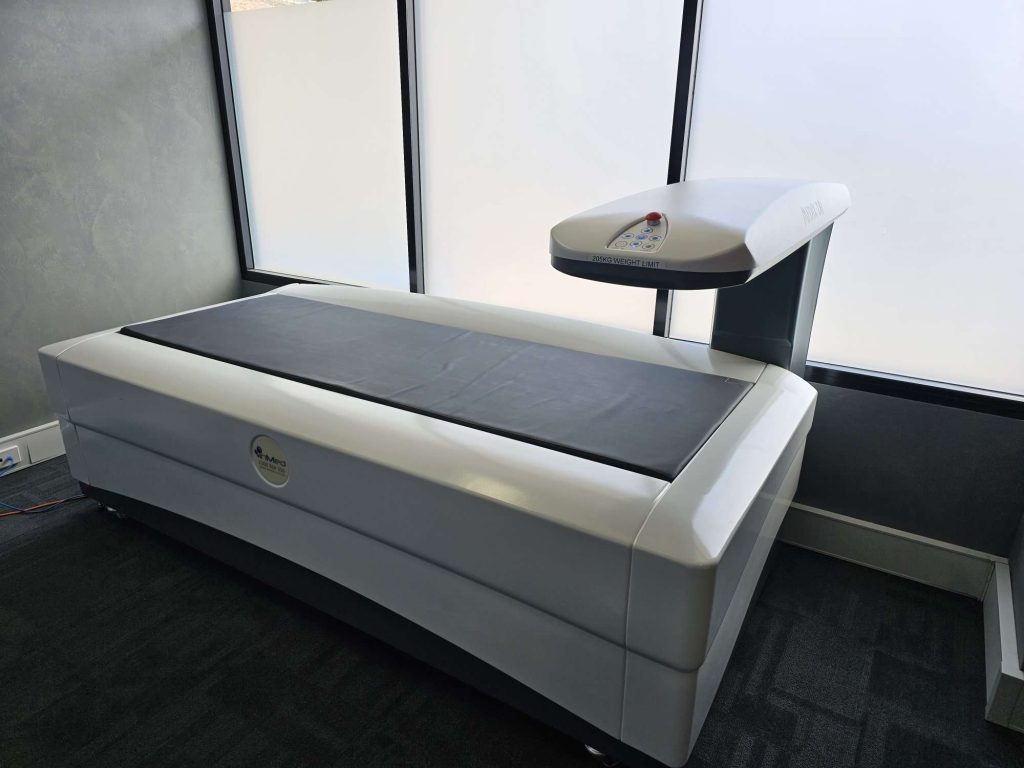
Understanding your body composition starts with understanding how it is measured. While many tools claim to assess body fat or muscle mass, very few explain the science behind how those numbers are generated. This is where DEXA scanning stands apart. Rather than relying on estimates or predictive formulas, DEXA uses clinically validated imaging technology to measure body composition directly.
DEXA, short for Dual-Energy X-Ray Absorptiometry, has been used in medical and research settings for decades. Its ability to accurately differentiate fat mass, lean mass and bone mass has made it the reference standard for body composition analysis. Unlike scales or calliper-based methods, DEXA provides a complete picture of how tissues are distributed throughout the body, including regional muscle balance and visceral fat levels.
In this article, we explain how DEXA scans work at a scientific level, why dual-energy X-ray technology is so accurate, and what makes DEXA results consistent and reliable over time. By understanding the science behind the scan, you will be better equipped to interpret your results and make informed decisions about your health, fitness and long-term wellbeing.
Key Takeaways
- DEXA uses dual-energy X-ray technology to directly measure body composition
- Different tissues absorb X-ray energy differently, allowing precise separation of fat, lean mass and bone mass
- DEXA body composition scans measure bone mass, not Bone Mineral Density (BMD)
- The same DEXA technology is used for medical BMD exams, which follow a separate protocol, are done on the same machine, and are reported by a Radiologist
- DEXA provides regional body composition and visceral fat analysis that other methods cannot
- Results are highly consistent and repeatable, making DEXA ideal for long-term tracking
Summary Table: How DEXA Scans Work
| Aspect | DEXA Scan Technology |
| What it does | Uses dual-energy X-ray beams to differentiate fat, lean tissue and bone |
| What it measures | Fat mass, lean mass, bone mass, visceral fat, regional body composition |
| Accuracy | Very high, based on direct measurement rather than estimation |
| Consistency over time | Highly repeatable, with minimal influence from hydration or food intake |
| Clinical role | Used in medical, research and performance settings |
| Bone health assessment | Bone mass measured in body composition scans; Bone Mineral Density assessed in separate BMD exams |
What Is a DEXA Scan? A Quick Scientific Overview

DEXA stands for Dual-Energy X-Ray Absorptiometry, a medical imaging technique originally developed to assess bone health and later adapted for accurate body composition analysis. It allows clinicians and researchers to measure fat mass, lean mass and bone mass with a high degree of precision.
A DEXA scan uses two low-dose X-ray beams at different energy levels. As these beams pass through the body, fat tissue, lean tissue and bone absorb the energy differently. Specialised software analyses these differences to directly measure each tissue type, rather than relying on estimates or predictive formulas. This direct measurement approach is what separates DEXA from many other body composition methods.
DEXA has been used for decades in hospitals, universities and research institutions due to its accuracy and consistency. The same technology is used for Bone Mineral Density (BMD) exams, which assess bone strength and fracture risk, as well as for body composition scans that focus on fat, muscle distribution and bone mass using a different protocol and software.
The scan itself is non-invasive, requires no injections or contrast agents, and exposes the body to only a very small amount of radiation. This combination of scientific reliability, low radiation exposure and reproducible results is why DEXA is widely regarded as the gold standard for body composition analysis.
The Science Behind Dual-Energy X-Ray Technology

The accuracy of a DEXA scan comes from its use of dual-energy X-ray beams, a method designed to distinguish different types of tissue based on how they absorb energy. Unlike single-energy imaging, which struggles to separate overlapping tissue types, dual-energy technology provides the contrast needed to measure body composition with precision.
During a DEXA scan, two X-ray beams at different energy levels pass through the body. Each tissue type interacts with these energy levels in a unique way. Bone, which is dense and mineral-rich, absorbs more X-ray energy than soft tissue. Lean tissue and fat tissue also absorb energy differently due to variations in density and composition. By comparing how each beam is absorbed, the scanner’s software can accurately classify and quantify fat mass, lean mass and bone mass.
This approach allows DEXA to measure tissues directly, rather than estimating them from external variables. Many other body composition methods rely on assumptions about hydration levels, body shape or population averages. DEXA avoids these assumptions by using physical differences in tissue properties, which significantly improves accuracy and repeatability.
Dual-energy technology also enables regional analysis, allowing the body to be divided into specific segments such as arms, legs, trunk and hips. This makes it possible to assess muscle balance, fat distribution and changes in specific areas over time. These insights are particularly valuable for tracking training adaptations, rehabilitation progress and long-term health trends.
By combining dual-energy X-ray physics with specialised analytical software, DEXA delivers a level of detail and consistency that other body composition tools cannot match. This scientific foundation is the reason DEXA has become the reference standard in medical, research and performance-focused environments.
How DEXA Differentiates Fat, Lean Tissue and Bone
DEXA differentiates fat, lean tissue and bone by analysing how each tissue absorbs dual-energy X-ray beams. Because these tissues have different densities and compositions, they interact with X-ray energy in predictable and measurable ways. This allows the scanner to classify each tissue type accurately.
Fat tissue absorbs less X-ray energy than lean tissue, while bone, due to its mineral content, absorbs significantly more. By comparing the absorption patterns from two energy levels, the DEXA system can separate these tissues and quantify them independently. This direct measurement is what allows DEXA to deliver precise body composition data rather than estimates.
In addition to total values, DEXA provides regional analysis, breaking the body into areas such as the arms, legs and trunk. This enables assessment of muscle distribution, fat storage patterns and left-to-right symmetry, which is particularly useful for tracking training progress, rehabilitation or long-term changes.
By measuring tissues directly and regionally, DEXA delivers a clear and practical understanding of how body composition is structured and how it changes over time.
Bone Mass vs Bone Mineral Density (BMD): Understanding the Difference
Bone mass and Bone Mineral Density (BMD) are closely related but measure different aspects of bone health, and the distinction is often misunderstood. A DEXA body composition scan measures bone mass, which reflects the total amount of bone tissue in the body and contributes to overall body composition analysis.
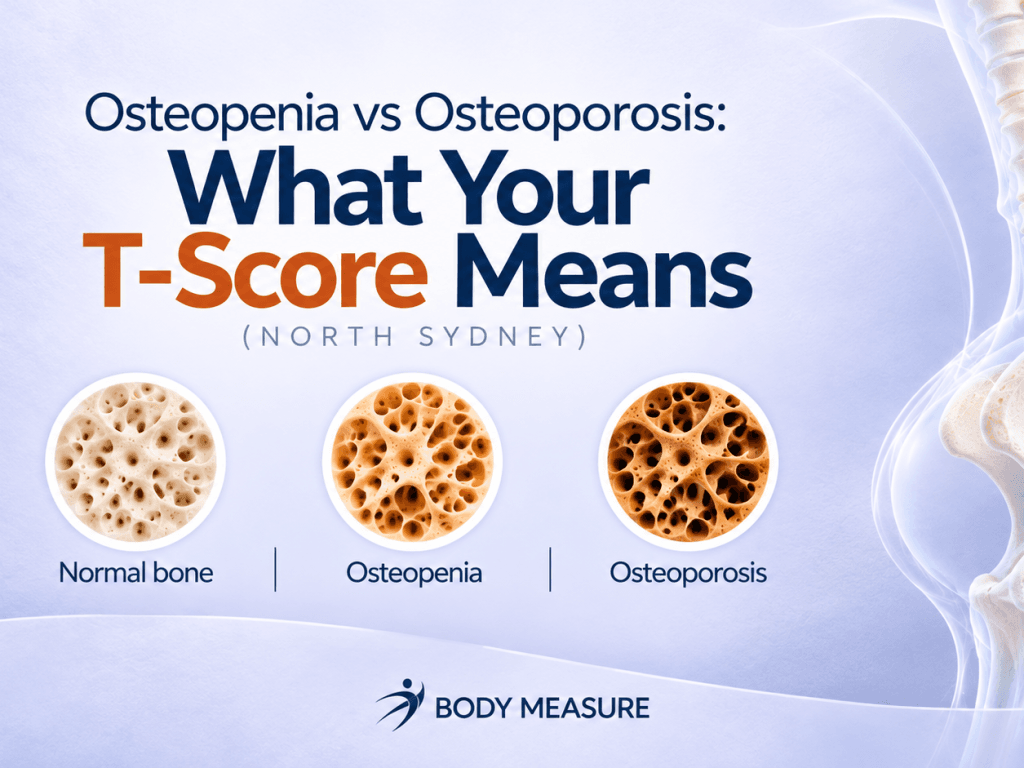
Bone mass alone does not indicate bone strength or diagnose conditions such as osteopenia or osteoporosis. To assess bone strength and fracture risk, a Bone Mineral Density (BMD) exam is required. While it uses the same DEXA technology, on the same machine, a BMD exam follows a separate medical protocol, uses different software and is reported by a Radiologist.
For individuals seeking a complete understanding of their body composition and bone health, some may benefit from having both a body composition DEXA scan and a BMD exam. Together, these provide insight into overall tissue distribution as well as clinically validated bone density information.
Measuring Visceral Fat and Regional Body Composition

Visceral fat is the fat stored around internal organs such as the liver and intestines. Unlike subcutaneous fat, visceral fat is metabolically active and is associated with increased risk of conditions, including cardiovascular disease and insulin resistance. Measuring visceral fat accurately is therefore important for understanding metabolic health.
DEXA is one of the few non-invasive methods capable of estimating visceral fat reliably. Using specialised analysis of the abdominal region, DEXA provides an objective measure of internal fat that cannot be assessed through BMI or skinfold testing.
In addition to visceral fat, DEXA delivers regional body composition analysis, dividing the body into segments such as arms, legs and trunk. This allows for assessment of muscle balance, fat distribution and asymmetries. These insights are useful for tracking training adaptations, rehabilitation progress and long-term health changes.
Why DEXA Results Are So Consistent and Repeatable
One of the key advantages of DEXA scanning is the consistency of its results over time. Because DEXA measures body composition using dual-energy X-ray absorption, results are not significantly affected by hydration levels, recent meals or exercise, which commonly influence other testing methods.
Many body composition tools rely on assumptions about body water or population-based formulas. Small changes in these variables can create misleading fluctuations from one test to the next. DEXA avoids this by measuring physical tissue properties directly, allowing genuine changes in fat, lean mass and bone mass to be tracked accurately.
Consistency is particularly important when body composition data is used to guide decisions. Reliable results make it easier to assess whether a training program is effective, whether fat loss is truly occurring, or whether muscle mass is being maintained over time. Because DEXA minimises measurement variability, it provides confidence that changes seen between scans reflect real physiological adaptations rather than testing noise.
This high level of repeatability makes DEXA especially valuable for long-term tracking. When changes appear in DEXA results, they are far more likely to represent meaningful progress, enabling informed adjustments to training, nutrition or health strategies.
Is DEXA Safe? Radiation Exposure Explained
DEXA scans use a very low dose of radiation, significantly lower than many common medical imaging procedures. The amount of radiation exposure from a DEXA body composition scan is comparable to natural background radiation received during everyday activities and is considered minimal.
Because of this low exposure level, DEXA is widely regarded as safe for repeated use when appropriate. This makes it suitable for individuals who wish to track body composition changes over time without concern about excessive radiation exposure.
As with any medical imaging, scanning frequency should be guided by individual goals and circumstances. For most people using DEXA for body composition tracking, the radiation exposure remains well within accepted safety limits.
What Happens During a DEXA Scan
A DEXA scan is a simple and non-invasive procedure. During the scan, you lie flat on a padded table while the scanner passes slowly over your body. You are required to remain still, but the scan itself is completely painless.
The scanning process typically takes 5-7 minutes. There are no injections, no contrast agents and no enclosed spaces, making it comfortable for most people. You can breathe normally throughout the scan, and there is no sensation from the X-ray beams as the scanner moves overhead.
After the scan, the data is processed using specialised software to generate a detailed body composition report. These results provide clear insights into fat mass, lean mass, bone mass, visceral fat and regional distribution, which can then be used to guide health, fitness or performance decisions.
Why DEXA Is Considered the Gold Standard
DEXA is considered the gold standard for body composition analysis because it combines scientific accuracy with practical usability. By using dual-energy X-ray technology, DEXA measures fat mass, lean mass and bone mass directly, rather than estimating these values through formulas or assumptions.
The level of detail provided by DEXA sets it apart. In addition to total body composition, it offers regional analysis and visceral fat assessment, allowing for deeper insight into how the body is structured and how it changes over time. This makes DEXA valuable not only in medical and research settings, but also for individuals focused on long-term health, fitness and performance.
Most importantly, DEXA delivers consistent and repeatable results. This reliability allows meaningful tracking and confident decision-making, which is why DEXA continues to be trusted across clinical, research and performance-focused environments.
Final Thoughts
Understanding how DEXA scans work helps explain why they are trusted for accurate body composition analysis. Rather than relying on estimates or assumptions, DEXA uses established imaging technology to measure fat mass, lean mass and bone mass directly.
This scientific foundation, combined with low radiation exposure and consistent results, makes DEXA a reliable tool for tracking meaningful changes over time. Whether the goal is improving health, monitoring fitness progress or gaining clearer insight into body composition, understanding the technology behind the scan allows results to be interpreted with confidence.
By focusing on accuracy and repeatability, DEXA provides information that supports informed, long-term decision-making.
FAQs Answered
How long does a DEXA scan take?
A DEXA body composition scan typically takes 5-7 minutes, and with the consult expect to be there for 20 minutes in total.The process is simple and non-invasive, with no injections or enclosed spaces. You lie still on a padded table while the scanner passes slowly over your body.
Can hydration or food affect DEXA scan results?
Hydration and recent food intake have minimal impact on DEXA results. Unlike methods such as BIA, DEXA measures tissue directly rather than relying on body water assumptions. For best consistency when tracking changes over time, it is recommended to scan under similar conditions for each visit.
Who should consider getting a DEXA scan?
A DEXA scan is suitable for anyone seeking an accurate understanding of their body composition. It is particularly useful for individuals tracking fat loss or muscle gain, athletes monitoring performance, people interested in metabolic health, and those wanting reliable long-term tracking data.
What makes dual-energy X-ray technology more accurate than other body composition tests?
Dual-energy X-ray technology uses two different energy levels to distinguish between fat, lean tissue and bone based on how each absorbs X-ray energy. This allows DEXA to measure tissues directly, rather than estimating them through formulas, resulting in greater accuracy and repeatability.
Does a DEXA scan measure bone density or bone mass?
A DEXA body composition scan measures bone mass, which reflects the amount of bone tissue in the body. To assess bone strength and fracture risk, a Bone Mineral Density (BMD) exam is required. BMD exams use the same DEXA technology but follow a separate medical protocol and are reported by a Radiologist.
Is a DEXA scan safe, and how much radiation does it use?
DEXA scans use a very low dose of radiation, comparable to natural background radiation experienced during daily life. This level of exposure is considered minimal, making DEXA safe for body composition assessment when used appropriately.
How often can you safely get a DEXA scan?
For body composition tracking, scans are often performed every 8 to 12 weeks, depending on individual goals. Because radiation exposure is low, DEXA can be used safely for periodic monitoring when clinically appropriate.
Do you need a referral for a DEXA body composition scan in Australia?
No referral is required for a DEXA body composition scan. Appointments can be booked directly. Referrals are only required for Medicare-rebated Bone Mineral Density (BMD) exams.