Confused by osteopenia vs osteoporosis on your bone density scan result? You’ve probably already looked up your T-score.
This article covers the part that matters more: what the diagnosis actually means for you.
Near North Sydney? Body Measure’s clinic in St Leonards is a short trip from North Sydney, Crows Nest. The same DEXA bone density scan referenced throughout this article is available locally, with results explained the same day.
THE SHORT VERSION
Three things to know before you read on
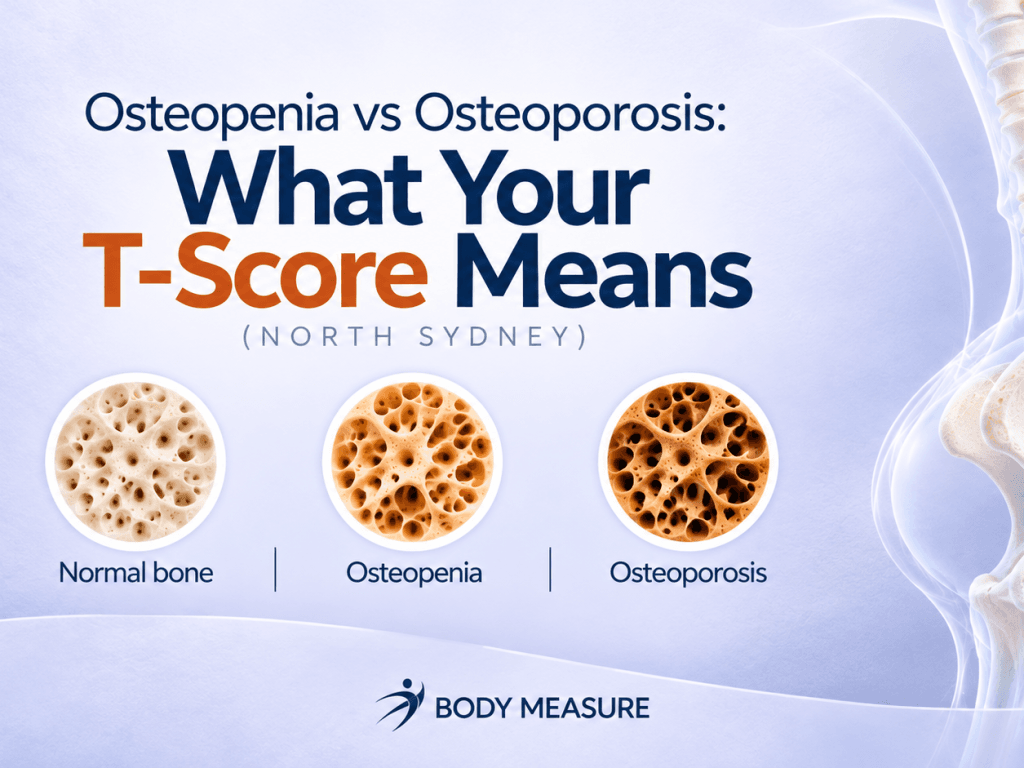
Osteopenia
Bone density that is lower than normal, but not low enough to be classed as osteoporosis.
Osteoporosis
Bones that have lost enough density to become porous and fragile, and far more prone to fracture.
Not inevitable
Having osteopenia does not mean osteoporosis will follow. Most people with osteopenia never progress.
~50%
of fractures in people over 50 happen in those with osteopenia, not osteoporosis
Source: Healthy Bones Australia
23%
of Australian women over 50 are estimated to have osteoporosis.
SIDE BY SIDE
Two diagnoses, two different conversations
The T-score ranges are only the start. This is what each result usually means in practice.
- Fracture risk
- Higher than normal
- Symptoms
- Usually none
- Progression
- Does not always lead to osteoporosis
- Typical approach
- Monitoring, lifestyle changes and a review of risk factors
- Fracture risk
- Significantly higher
- Symptoms
- Usually none until a fracture occurs
- Progression
- An ongoing condition that needs management
- Typical approach
- Monitoring plus, in many cases, medical treatment
Does osteopenia always turn into osteoporosis?
No.
Osteopenia means your risk is elevated, not that the outcome is fixed. Your doctor will weigh up how low your bone density is, your age, and your personal risk factors to decide how closely to monitor you.
Both conditions share many of the same risk factors:
- Age (bone density naturally declines over time)
- Menopause and reduced oestrogen levels
- Family history of osteoporosis or fractures
- Low body weight
- Smoking and excessive alcohol intake
- Low calcium or vitamin D intake
- Certain medications and medical conditions
What happens next
- Get your result
A bone mineral density DEXA scan gives you your T-score and Z-score.
- Agree a plan
This usually covers calcium, vitamin D and weight-bearing exercise as guided by a professional.
- Track the trend
One scan is a snapshot. Repeat scans, often every 1 to 5 years for osteopenia, show whether your bone health is stable, improving or declining.
FAQs
Is osteopenia serious?
Osteopenia itself isn’t a disease, but it does mean a higher-than-normal fracture risk and is worth monitoring, especially for people over 50 or with other risk factors.
Can osteopenia be reversed?
In many cases, bone density can be stabilised or improved with adequate calcium, vitamin D, weight-bearing exercise and addressing any underlying risk factors — though this varies by individual and should be guided by your doctor.
How often should I get scanned if I have osteopenia or osteoporosis?
This depends on your individual risk factors and baseline result. Your doctor can recommend an appropriate interval, often somewhere between 1 and 5 years for osteopenia monitoring.
What's the difference between osteopenia and osteoporosis symptoms?
Neither condition typically causes noticeable symptoms. Osteoporosis is often only discovered after a fracture occurs, which is why screening matters even without symptoms.
Where can I get a bone density scan near North Sydney?
Body Measure’s clinic in St Leonards is a short trip from North Sydney, Crows Nest. The DEXA bone density scan covered in this article is available locally, with results explained the same day.
Know where your bones stand.
Book a bone density scan near North Sydney and get your T-score and Z-score explained clearly, with real data to track over time.